The Three-Ingredient Budget Miracle That Tastes Like Sunday Dinner — Taught by a Neighbor Who Fed Six Kids on One Income and Never Once Compromised on Comfort
Some of the most valuable cooking knowledge in the world does not live in cookbooks or culinary schools or food magazines. It lives in the kitchens of people who learned through genuine necessity — who discovered, through years of stretching every dollar and still managing to put something warm and satisfying on the table every single night, that the most honest and most comforting food almost always comes from the shortest ingredient lists. Slow Cooker Poor Man’s Potatoes and Gravy is exactly that kind of knowledge, passed down exactly that way — one neighbor to another, across a fence or a kitchen table, with the simple confidence of someone who has made this dozens of times and knows with complete certainty that it works.
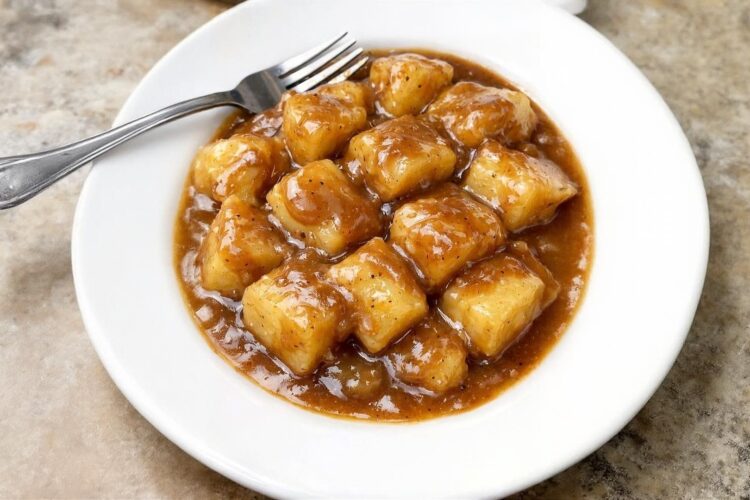
Three ingredients. Two pounds of peeled russet or Yukon Gold potatoes cut into chunks, two packets of dry brown gravy mix whisked into three cups of water, and a slow cooker that does everything else while the day goes on around it. By suppertime, what is waiting inside that insert is something that defies the arithmetic of its ingredients entirely — tender, fork-yielding potato chunks swimming in thick, glossy, deeply savory brown gravy that tastes like the accompaniment to a proper Sunday roast dinner, complete with all the richness and comfort that suggests, without any of the expense or effort the phrase normally implies. It is humble food made with complete sincerity, and it is extraordinarily good.
🥔 Why This Recipe Matters More Than Its Three Ingredients Suggest
- 💰 Genuinely, Remarkably Budget-Friendly: Two pounds of potatoes and two packets of gravy mix cost a fraction of almost any other satisfying dinner on the market — and yet the finished dish delivers comfort and substance that make it feel like something considerably more valuable than its price tag suggests.
- 🍗 Tastes Like Sunday Roast Without the Roast: The brown gravy, slowly cooked with the potatoes for six to seven hours, absorbs the starch released by the potatoes as they cook and develops a richness, depth, and glossy body that makes it taste genuinely home-cooked and carefully made rather than assembled from a packet and water.
- ⏱️ Five Minutes of Prep, Hours of Hands-Off Cooking: Peel the potatoes, whisk the gravy mix into water, pour, cover, and walk away. The slow cooker handles everything else without a single additional minute of your attention.
- 🏡 The Definition of Cold Evening Comfort: There is something about thick brown gravy pooled around tender potato chunks in a shallow bowl with a slice of bread alongside that hits a deeply satisfying note on a cold weeknight that more elaborate dinners often fail to reach.
- 🔄 A Perfect Base for Stretching and Customizing: Serve over rice, egg noodles, or thick toast to feed more people from the same pot. Add a sliced onion, a cup of broth instead of water, a spoonful of sour cream at the end — the recipe welcomes each addition graciously without losing its essential simplicity.
📖 The Philosophy of Cooking With Almost Nothing
The neighbor who passed this recipe down fed six children on one income without ever making the table feel like a place of deprivation — and that achievement requires a specific kind of culinary wisdom that is genuinely worth understanding. It is not the wisdom of abundance or of technique or of culinary education. It is the wisdom of knowing which few ingredients, combined in the right way with enough time and heat, produce maximum comfort and satisfaction per dollar spent.
Potatoes have anchored this kind of cooking for centuries across cultures and continents — in Irish farmhouses, in Depression-era American kitchens, in Midwestern farmhouses where the root cellar full of potatoes was the difference between worry and supper. They are calorie-dense, deeply filling, available everywhere at minimal cost, and capable — when cooked long enough and with even the simplest sauce — of tasting genuinely luxurious. The dry gravy mix is the modern convenience that does the seasoning work of what would have required a proper beef broth and a careful roux in earlier generations of this type of cooking, delivering a concentrated, savory, deeply flavored liquid that slow-cooks into the potatoes over hours and produces a result that tastes far more complex than a packet of powder and water have any right to.
Together, these three things produce something that a six-child household could eat with genuine pleasure — and that an adult eating it for the first time on a cold evening will understand immediately has been underestimated.
🛒 What You Will Need
Servings: 4 | Equipment: slow cooker (any size from 4-quart up)
- 2 lbs russet or Yukon Gold potatoes, peeled and cut into 1 to 1½-inch chunks — the choice between russet and Yukon Gold produces meaningfully different results worth considering. Russet potatoes are higher in starch, which means they absorb the surrounding gravy more readily during the long cook and their edges soften and begin to release starch into the liquid, naturally thickening the gravy further as the hours pass. Yukon Gold potatoes are waxier, holding their shape more distinctly and providing a creamier, more buttery texture in the finished dish — they absorb less gravy but remain more visually intact when served. Both are excellent choices; the decision comes down to whether you prefer a slightly creamier potato with more structural definition or a slightly softer potato with a thicker, more starch-enriched gravy surrounding it. Cut them into uniform 1 to 1½-inch chunks — consistent sizing ensures every piece is fully tender at the same time.
- 2 packets (0.8–1 oz each) dry brown gravy mix — the seasoning and thickening agent for the entire dish. Two packets rather than one provide a more robustly flavored, more deeply colored, more satisfying gravy than a single packet would in this quantity of water. Different brands vary in their sodium content and flavor intensity — if you are sodium-sensitive, look for low-sodium gravy mix and taste the finished dish before adding any additional salt. The gravy will look extremely thin when first whisked with the water, but it thickens significantly during the long cooking time as the potato starch releases into the surrounding liquid and as the liquid reduces gradually in the covered slow cooker.
- 3 cups water — whisked with the gravy mix to form the cooking liquid. Plain water is the traditional and most economical choice, but substituting one cup of the water with beef or vegetable broth deepens the flavor considerably if you have it available. The slow cooker’s covered cooking environment prevents the liquid from evaporating significantly during the long cook, meaning the three cups of water produces a proper, coating gravy rather than cooking down to a thick paste.
👨🍳 Step-by-Step Method
Prep time: 10 minutes | Cook time: 6–7 hours on LOW or 3–4 hours on HIGH | Servings: 4
Step 1 — Prepare the Potatoes: Peel the potatoes and cut them into uniform chunks of approximately 1 to 1½ inches. Rinse the cut pieces briefly under cool water to remove some of the surface starch — this optional step produces a slightly clearer gravy. Lightly grease the inside of the slow cooker insert with a small amount of oil or a quick spray of nonstick cooking spray to prevent the potatoes from adhering to the bottom and sides during the long cook.
Step 2 — Layer the Potatoes: Place all the potato chunks in an even layer on the bottom of the slow cooker insert, spreading them as uniformly as possible so they cook at a consistent rate.
Step 3 — Make the Gravy: In a medium bowl or large measuring cup, combine both packets of dry brown gravy mix with the 3 cups of water. Whisk vigorously until the powder is completely dissolved and no lumps remain — the mixture will look quite thin at this stage, almost like pale brown water, and this is entirely correct. It thickens substantially during the long slow cooker cycle.
💡 Pro Tip: For a noticeably deeper, more complex gravy flavor that still honors the spirit of this three-ingredient recipe, substitute one of the three cups of water with an equal amount of beef broth. The broth adds a genuine beef richness that makes the finished gravy taste considerably more like a proper roast dinner accompaniment without adding meaningful expense or complication.
Step 4 — Pour and Cover: Pour the whisked gravy mixture evenly over the potato chunks in the slow cooker, ensuring that most of the potato surfaces are at least partially submerged in the liquid. Place the lid firmly on the slow cooker and cook on LOW for 6 to 7 hours or HIGH for 3 to 4 hours, until the potatoes are completely fork-tender with no resistance whatsoever when pierced at their thickest point. Do not lift the lid during cooking — the steam that builds inside the sealed insert is part of what cooks the potatoes evenly and what the gravy needs to reach the right consistency.
Step 5 — Check and Adjust the Gravy: When the potatoes are fully tender, remove the lid and gently stir from the bottom of the insert to coat all the potato chunks in the thickened gravy. Assess the consistency — the gravy should be thick enough to coat a spoon and cling to the potato surfaces rather than running off. If it seems thinner than you would like, leave the lid off, switch to HIGH, and cook for an additional 15 to 20 minutes, stirring once or twice, to allow the liquid to reduce and concentrate slightly.
Step 6 — Season and Serve: Taste the gravy before adding any salt — most gravy mix packets provide sufficient seasoning without any addition, and over-salting at this stage cannot be corrected. Add a pinch of black pepper, which brightens all the flavors and gives the dish a classic Sunday dinner finish. Serve hot in shallow bowls or on flat plates, spooning generous amounts of the gravy over the top of the potatoes so it pools attractively around the edges.
🍽️ Serving Suggestions and Storage
These potatoes and gravy are complete enough to serve as a simple, satisfying main course alongside a green vegetable — steamed peas are the most traditional and beloved accompaniment, their sweetness contrasting beautifully with the savory gravy. Green beans, roasted broccoli, or a simple garden salad all work equally well. For the complete Sunday dinner feeling, a basket of warm dinner rolls or biscuits for soaking up the extra gravy is entirely necessary. For stretching the meal to feed more people from the same pot, spoon the potatoes and gravy over cooked white rice, buttered egg noodles, or thick-cut toast — all three absorb the gravy beautifully and extend the dish into territory that feeds six just as easily as four. For storage, refrigerate cooled leftovers in shallow airtight containers within 2 hours and use within 3 to 4 days. The gravy will thicken considerably during refrigeration — add a small spoonful of water while reheating on the stovetop or in the microwave and stir until the sauce loosens back to its original consistency.
💡 Tips and Variations
For added sweetness and savory depth without adding meaningful expense, place a small yellow onion thinly sliced beneath the potatoes before pouring the gravy over — the onion cooks down completely and dissolves into the surrounding gravy during the long cook, adding a natural sweetness and depth that makes the finished dish taste significantly more complex. For a creamier, richer version, stir a generous spoonful of sour cream or a splash of whole milk directly into the hot gravy immediately before serving — the dairy rounds the flavor and gives the sauce a luxurious, velvety quality that makes it taste considerably more indulgent. For additional protein without significant cost, stir in 1 cup of cooked, shredded rotisserie chicken during the final 30 minutes of cooking — the chicken warms through in the gravy and makes the dish substantially more filling and protein-forward. For a lower-sodium version, use one packet of low-sodium gravy mix and one packet of standard, taste at the end, and season accordingly.
❓ Frequently Asked Questions
My gravy was too thin even after the full cooking time — what should I do? Remove the lid, increase to HIGH, and cook uncovered for 20 to 30 minutes, stirring every 10 minutes. The evaporation during the uncovered cook will concentrate the liquid and the continued release of starch from the potatoes will thicken the gravy significantly. Alternatively, mix one tablespoon of cornstarch with two tablespoons of cold water and stir the slurry into the hot gravy — it will thicken within 5 minutes.
Can I add meat to this recipe? Absolutely — small pieces of stew beef, pork shoulder, or chicken thighs placed beneath the potatoes before the gravy is poured over will cook through completely during the long slow cooker cycle. The meat releases additional juices into the surrounding gravy and makes the finished dish taste remarkably like a proper pot roast in miniature, at a fraction of the cost.
My potatoes turned slightly mushy — what went wrong? The potatoes either cooked for too long or were cut too small. Cut them into the full 1 to 1½-inch chunks rather than smaller pieces, and begin checking for doneness at the earlier end of the time range. Once a fork slides through a chunk with no resistance, the potatoes are done and should be served as soon as possible.
🌟 A Final Word
Three ingredients. Ten minutes of prep. A slow cooker doing patient, quiet work for most of the day. And a bowl of something at suppertime that tastes like someone who loves you cooked all afternoon.
That is the complete story of Poor Man’s Potatoes and Gravy — and it is a story that has fed countless families through countless tight weeks without ever making the table feel like a place of lack or deprivation. The neighbor who taught this recipe understood something fundamental about comfort food: that it is not the expense of the ingredients or the complexity of the preparation that makes food feel like a gift. It is the warmth, the filling satisfaction, the thick gravy pooling around tender potato chunks in a shallow bowl on a cold evening, and the knowledge that someone thought to make something good for the people they were feeding. Three ingredients can do all of that. This recipe does it every time.