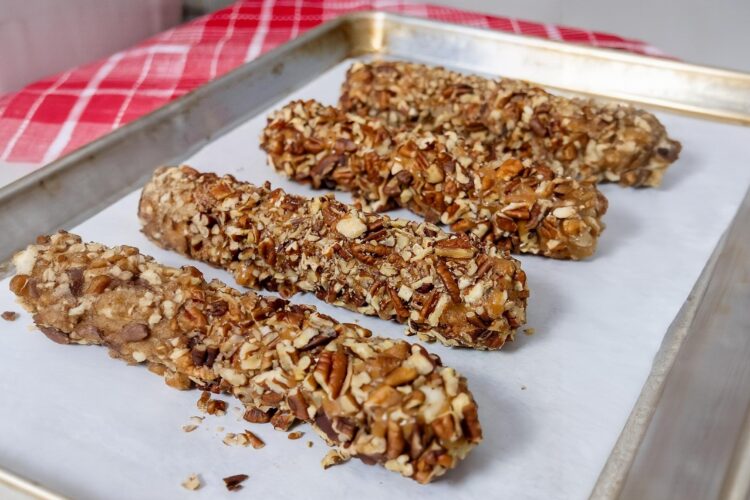
The Iconic Road Trip Candy With a Creamy Vanilla Nougat Center, Sticky Caramel Coating, and a Generous Crust of Toasted Pecans — Made Entirely at Home
There are certain foods that belong to a very specific kind of memory — not the memory of a kitchen or a holiday table, but the memory of motion, of long stretches of highway, of the particular anticipation that comes from spotting a roadside sign and knowing that a stop is coming. For millions of Americans who grew up taking road trips through the South and Midwest in the mid-20th century, Pecan Logs are exactly that kind of memory food. A chewy, sticky, deeply satisfying candy built from a soft vanilla nougat core wrapped in a layer of molten caramel and rolled until completely encrusted in chopped pecans — it is the kind of treat that people who have not thought about it in decades can still taste the moment someone mentions it by name.
The Pecan Log was popularized by Stuckey’s, the legendary Georgia roadside candy and pecan shop chain founded in the 1930s by a pecan farmer named W.S. Stuckey Sr. who began selling his family’s pecans from a roadside stand during the Great Depression. As Stuckey’s locations multiplied along American highways over the following decades, the Pecan Log became one of its most beloved signature items — the thing families bought at every stop, the candy that defined what a road trip tasted like for a generation of American children. At its peak, Stuckey’s operated over 350 locations across the country, and the Pecan Log traveled with them to every one.
Today, Stuckey’s locations are far fewer and far between than they once were, which means many people who grew up loving this candy can no longer find it easily. The good news is that making your own at home is entirely achievable, requires no candy thermometer or special equipment, and produces a result that is every bit as good as the original — arguably better, because you can make eight full logs from a single batch and give them as gifts, pile them on a holiday cookie plate, or simply keep them in the freezer and reach for one whenever the craving hits.
🍬 Why You Will Make This Candy Every Holiday Season
- 🎁 The Ultimate Homemade Gift: Eight logs per batch, each sliced into generous half-inch rounds, yields enough candy to fill multiple gift boxes, cookie tins, and holiday plates. Few homemade gifts are as universally appreciated as a box of handmade pecan logs.
- 🥜 That Texture Combination: The soft, yielding vanilla nougat center against the sticky, slightly chewy caramel coating against the crunchy, toasted pecans on the outside creates a layered textural experience that is genuinely unlike any other candy.
- 🌡️ No Candy Thermometer Required: Despite being a homemade candy, this recipe requires no thermometer, no soft-ball stage testing, and no specialized equipment beyond a saucepan, a heatproof bowl, and patience. The nougat comes together on the stovetop in minutes.
- ❄️ Freezer Friendly and Make-Ahead Perfect: The logs freeze beautifully both before and after coating, making them an ideal project for anyone who likes to get holiday baking and candy-making done well in advance.
- 🏠 Nostalgia in Every Slice: Whether you grew up stopping at Stuckey’s on family road trips or are discovering this candy for the first time, there is something about the combination of vanilla, caramel, and pecans that tastes immediately familiar and deeply comforting.
📖 The Story of Stuckey’s and the Road Trip Candy That Defined an Era
To fully appreciate what a Pecan Log is and why it matters, you need to understand the cultural moment that created it. When W.S. Stuckey opened his first roadside pecan stand in Eastman, Georgia in 1937, American road culture was just beginning to emerge as a genuine phenomenon. As the Interstate Highway System expanded in the 1950s and families began taking long-distance road trips in unprecedented numbers, Stuckey’s positioned itself perfectly — bright turquoise-roofed buildings visible from the highway, promising travelers a place to stretch their legs, use the restroom, and most importantly, buy candy and pecans to carry them through the miles ahead.
The Pecan Log became the crown jewel of the Stuckey’s candy case — a substantial, satisfying treat that held up well to being wrapped in a pocket or a glove compartment, that tasted extraordinary at room temperature, that was sweet and rich and filling enough to qualify as a legitimate road trip snack rather than a mere indulgence. Generations of American children grew up associating the sight of a Stuckey’s sign with the pleasure of a Pecan Log to come, and that association became so deeply embedded in American food memory that the candy has achieved a cultural status well beyond its humble ingredients.
Making it at home honors that tradition while making it accessible to anyone, anywhere — no highway required.
🛒 What You Will Need
Yield: 8 logs, each sliced into approximately 8–10 pieces | Equipment: medium saucepan, 9-inch baking dish, heatproof bowl, parchment paper, baking sheets
The Vanilla Nougat Center
- ½ cup salted butter (1 stick) — the fat base of the nougat that gives it richness and a smooth, yielding texture. Salted butter is specified and correct here — the salt balances the considerable sweetness of the powdered sugar and corn syrup and keeps the nougat from tasting cloying.
- ½ cup light corn syrup — provides the structural sweetness and the hygroscopic quality that keeps the nougat soft and chewy rather than crystallizing into a grainy, hard candy. Do not substitute with honey or maple syrup — their distinct flavors would compete with the vanilla and their different sugar compositions would produce an unpredictably different texture.
- ½ cup granulated sugar — contributes additional sweetness and dissolves into the butter and corn syrup to form the base of the nougat mixture.
- 4 cups powdered sugar — the primary bulk of the nougat, added off the heat to create the thick, pliable, workable consistency that can be pressed into the pan, cut into strips, and rolled into logs without crumbling or sticking excessively.
- ½ cup dry powdered milk — a traditional candy-making ingredient that adds a subtle dairy richness and a slight creaminess to the nougat texture that regular milk cannot provide in a dry mixture of this kind.
- 1 tsp pure vanilla extract — the defining flavor of the nougat center. Use pure vanilla extract rather than imitation for the cleanest, most aromatic, most genuine vanilla flavor in the finished candy.
The Caramel Coating
- 16 oz prepared caramels — store-bought individually wrapped caramel candies, melted down into a smooth, dippable coating. Using prepared caramels eliminates the need to make caramel from scratch and removes the most technically demanding step in what is otherwise a very accessible recipe. Werther’s soft caramels or standard individually wrapped caramels both work beautifully.
- 4 to 5 tablespoons whole milk — added to the melting caramels to thin them to the right consistency for dipping — fluid enough to coat the logs completely and evenly without being so thin that it runs off before the pecans can be applied. Start with 4 tablespoons and add the fifth only if the caramel seems too thick for smooth dipping.
The Pecan Crust
- 4 cups chopped pecans — and yes, four cups is the correct amount. The pecan crust needs to be thick, generous, and completely covering every surface of every log — a thin or sparse pecan coating defeats the entire purpose and character of this candy. Chop the pecans to a medium, irregular texture — small enough to roll easily around the caramel-coated logs but large enough to provide a satisfying crunch in every bite.
👨🍳 Step-by-Step Method
Prep time: 20 minutes | Cook time: 10 minutes | Inactive time: 2 hours | Total time: approximately 2.5 hours | Yield: 8 logs
Step 1 — Prepare the Pan: Grease a 9-inch baking dish thoroughly with nonstick spray, making sure to coat the entire bottom and sides. Set aside and keep it within reach — the nougat mixture will need to go into this dish quickly once it is made, as it thickens rapidly off the heat.
Step 2 — Make the Nougat Base: In a medium saucepan over medium heat, combine the salted butter, light corn syrup, and granulated sugar. Stir constantly as the butter melts and the sugar begins to dissolve, continuing to stir until the mixture is completely combined and comes to a simmer with small bubbles breaking across the entire surface. The moment it reaches a full simmer, remove the pan from the heat immediately — do not let it continue to boil, as overcooking at this stage will make the nougat hard and brittle rather than soft and chewy.
Step 3 — Add the Dry Ingredients: With the pan off the heat, add the powdered sugar, dry powdered milk, and vanilla extract to the hot butter-sugar mixture all at once. Stir vigorously and continuously — the mixture will immediately thicken dramatically and become difficult to stir as the powdered sugar absorbs the hot liquid. Keep stirring with determination until everything is fully incorporated and the mixture forms a thick, smooth, unified mass that pulls away from the sides of the pan. This will take 2 to 3 minutes of sustained stirring and the mixture will be quite stiff by the time it is done — this is correct.
Step 4 — Press and Cool: Transfer the nougat mixture to the prepared baking dish and press it out into an even, flat layer covering the entire bottom of the dish. Use the back of a spoon, a greased spatula, or greased fingertips to smooth the surface as flat and uniform as possible — even thickness means even-sized logs when you cut it. Let the nougat rest at room temperature until it is cool to the touch and firm enough to cut cleanly, approximately 30 minutes.
Step 5 — Cut into Strips: Once fully cooled, use a sharp knife to cut the nougat into 4 even strips running the length of the dish, then cut each strip in half down the center, giving you 8 equal rectangular pieces. The cuts should be clean and decisive — a sharp knife rather than a dull one will produce clean edges rather than ragged, compressed ones.
Step 6 — Roll into Logs: Working with one piece at a time, place each rectangular piece of nougat on a clean sheet of parchment paper. Using your hands, gently roll and shape it into a smooth, even log shape with rounded ends. The nougat is pliable and forgiving at this stage — if it cracks slightly as you roll it, simply press the cracks back together with your fingers and continue. Place each finished log on a parchment-lined baking sheet. Once all 8 logs are shaped, transfer the entire baking sheet to the freezer and freeze for 1 to 2 hours until the logs are completely solid throughout. Fully frozen logs are essential for the next step — a soft log will deform and lose its shape when dipped in warm caramel.
Step 7 — Make the Caramel Coating: Fill a saucepan with about an inch of water and bring it to a steady simmer over medium heat. Place a heatproof bowl that fits over the saucepan without touching the water on top to create a double boiler. Add the unwrapped caramels and 4 tablespoons of milk to the bowl. Stir constantly as the caramels slowly melt into the milk, breaking up any pieces that stick together and keeping the heat gentle and even. The double boiler method is important here — direct heat will scorch the caramel quickly, creating a bitter, grainy coating. Continue stirring until the caramel is completely smooth, glossy, and fluid. If it seems too thick for easy dipping, stir in the remaining tablespoon of milk. Keep the bowl over the simmering water throughout the dipping process to maintain a consistent dipping temperature.
Step 8 — Spread the Pecans: While the caramel melts, spread the 4 cups of chopped pecans out in a single, generous layer in a wide, shallow dish or rimmed baking sheet — wide enough to roll a full log through without pecans spilling over the sides. Set it directly beside your caramel station so the transfer from caramel to pecans can happen without delay.
Step 9 — Dip and Roll: Working with one frozen log at a time, use a fork to lower the log into the warm caramel, turning it to coat all surfaces completely. Lift it out of the caramel on the fork and allow the excess to drip back into the bowl for a few seconds — just enough to remove the dripping excess without losing the full coating. Immediately drop the caramel-coated log into the shallow dish of chopped pecans and roll it back and forth, pressing gently but firmly as you go, until the entire surface of the log is densely coated with pecans with no visible caramel showing through. Transfer the finished log to a parchment-lined baking sheet and repeat with the remaining seven logs, working quickly so the caramel stays warm and fluid throughout.
💡 Pro Tip: If the caramel starts to thicken and become too stiff for easy dipping midway through the process, return the bowl to the simmering water and stir for a minute until it loosens again. Do not add more milk to a thickened caramel — the water content will make it grainy.
Step 10 — Slice and Serve: Once all 8 logs are coated, allow them to set at room temperature for 15 minutes until the caramel is firm and the pecans are set. Using a sharp knife, slice each log into ½-inch rounds. Each log will yield approximately 8 to 10 slices, giving you a total of 64 to 80 individual pieces of candy from a single batch. Arrange on a serving plate, a cookie tin, or in a gift box lined with parchment.
🎁 Storing, Gifting, and Making Ahead
For room temperature storage, arrange the sliced rounds in a single layer in an airtight container with parchment paper between layers and keep at room temperature for up to 1 week — the caramel and nougat both hold well without refrigeration in a cool kitchen. For longer storage, refrigerate for up to 3 weeks in an airtight container, bringing to room temperature for 15 minutes before serving for the best texture. For gifting, arrange slices in a single layer in a holiday tin lined with parchment, or stack them in a cellophane bag tied with a ribbon. For make-ahead preparation, freeze the uncoated nougat logs in an airtight freezer bag for up to 3 months and complete the caramel-pecan coating whenever you are ready to serve or gift them — they go straight from freezer to caramel dip with no thawing required.
💡 Tips and Variations
For a deeper, more complex caramel flavor, add a pinch of flaky sea salt to the caramel just before dipping — salted caramel pecan logs are an extraordinary variation. For a chocolate version, dip the finished pecan-coated logs briefly in melted dark chocolate after the caramel and pecan coating has set fully — the chocolate adds a beautiful additional layer and makes them look even more like a premium candy shop creation. For a nut variation, substitute half the pecans with finely chopped roasted peanuts or cashews for a different crunch profile. For cleaner, more uniform slices, refrigerate the finished logs for 30 minutes before slicing — cold candy cuts more cleanly than room-temperature candy.
❓ Frequently Asked Questions
My nougat is too sticky to roll into logs — what should I do? Lightly grease your hands with a thin coating of butter or cooking spray before rolling — this prevents the nougat from sticking to your skin and makes the rolling process significantly easier and cleaner.
The caramel is sliding off the logs and pooling at the bottom — what went wrong? The logs were not frozen solid enough before dipping. Return them to the freezer for an additional hour and try again — a fully solid frozen log holds the caramel coating in place while it sets, while a partially thawed one lets it slide.
Can I make the nougat without powdered milk? The powdered milk contributes to both the flavor and texture of the nougat — omitting it will produce a slightly less rich, slightly less creamy result. If you cannot find powdered milk, substitute with an additional ¼ cup of powdered sugar as a rough texture substitute, understanding that the flavor will be slightly different.
🌟 A Final Word
Eight nougat logs. Sixty-plus slices of candy. A recipe that connects every person who tastes it to a specific chapter of American food history — the open highway, the turquoise roof, the particular pleasure of unwrapping something sweet in the front seat of a car heading somewhere new.
Making Pecan Logs at home is one of those small, satisfying acts of culinary preservation — keeping alive a candy and a tradition that deserves to outlast the roadside stops that made it famous. They are extraordinary gifts, magnificent additions to a holiday cookie plate, and deeply satisfying to make from scratch in your own kitchen. Once you have made a batch and sliced into that first log — the soft vanilla nougat giving way to the sticky caramel, the pecans crunching with every bite — you will understand completely why generations of American road trippers considered stopping for one of these the best part of the journey. Some things are worth making yourself. This is absolutely one of them.