Some of the best comfort food didn’t come from a test kitchen — it came from necessity. During the Great Depression, home cooks became experts at stretching a handful of pantry staples into meals that could feed a family without wasting a single ingredient. There was no room for anything fancy, just food that filled you up, used what was on hand, and somehow still managed to taste like care.
This slow cooker chicken and macaroni is a modern homage to that spirit. It takes just five ingredients — most of which are probably already in your kitchen — and turns them into a creamy, hearty, stick-to-your-ribs dinner with almost no hands-on effort. You don’t sauté anything, you don’t brown the chicken first, you don’t even cook the pasta separately. Everything goes into the slow cooker raw and finishes together, which is about as close to true dump-and-go cooking as a meal gets.
Why This Recipe Works With So Few Ingredients
It might seem surprising that a dish this minimal can turn out rich and creamy, but the method is doing more work than the ingredient list suggests. Condensed cream of chicken soup provides an instant flavor base and thickening power without requiring a separate roux or sauce-building step. Combined with chicken broth, it creates a cooking liquid that’s savory enough to season both the chicken and the pasta as everything simmers together for hours.
The dry elbow macaroni is really the key structural trick here. Rather than being boiled separately and added at the end, the pasta cooks directly in the broth-and-soup mixture, absorbing liquid as it softens and releasing its own starch back into the sauce in the process. That starch is what gives the finished dish its thick, glossy, almost stroganoff-like consistency, all without a single spoonful of flour or cornstarch added on purpose.
Meanwhile, the raw chicken breasts cook low and slow directly in that same liquid, which means they end up incredibly tender by the time you’re ready to shred them — no searing, no pre-cooking, no extra pan to clean.
A Few Things That Matter for Success
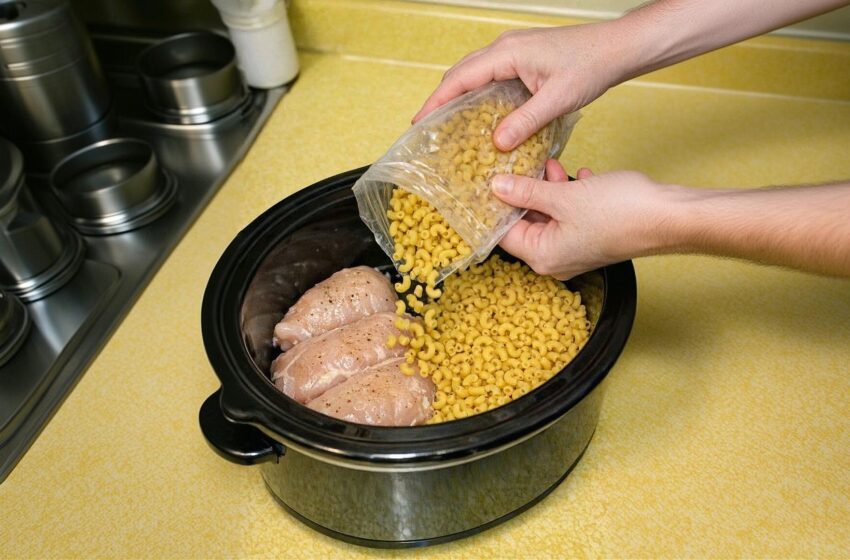
Keep the chicken and macaroni mostly separated when you first load the slow cooker. Placing the chicken breasts in a single layer on one side (rather than piled on top of each other) helps them cook evenly, while keeping the dry macaroni mostly on its own side means it has good contact with the liquid rather than being trapped underneath the chicken the whole time.
Don’t lift the lid early. It’s tempting to check on things, but every time the lid comes off, heat escapes and the cooking time gets extended. Since the pasta especially depends on steady, consistent heat to soften properly, resist opening the slow cooker during the first few hours.
Shred the chicken in the pot, not on a cutting board. Doing this directly in the slow cooker about 30 minutes before serving means the shredded chicken immediately reabsorbs some of that creamy sauce instead of drying out on a plate, and it saves you a dish.
Adjust the consistency at the end, not the beginning. The sauce continues thickening as the pasta absorbs liquid, so if it looks a little too thick once the chicken is shredded, a splash of extra broth or water stirred in gradually is the easiest fix — much easier than trying to thin it out earlier in the cooking process.
The Recipe
Servings: 4
Ingredients
- 1½ cups dry elbow macaroni
- 1½ pounds boneless, skinless chicken breasts (about 3–4 small breasts)
- 2 cans (10.5 ounces each) condensed cream of chicken soup
- 2 cups low-sodium chicken broth
- 1 teaspoon salt, or to taste
Directions
- Prep the slow cooker. Lightly grease the inside of the crock with a bit of oil or nonstick spray to keep the macaroni from sticking to the sides as it cooks.
- Add the chicken. Place the raw chicken breasts in a single layer on one side of the slow cooker, or down the center. They can touch each other, but avoid stacking them so they cook through evenly.
- Add the macaroni. Pour the dry elbow macaroni into the slow cooker beside the chicken, keeping it mostly on its own side. A few stray pieces falling near or under the chicken is completely fine — this recipe doesn’t need to look tidy going in.
- Whisk the sauce. In a medium bowl, whisk together the condensed cream of chicken soup, chicken broth, and salt until fairly smooth. It will look thin at this stage, but it thickens considerably once the pasta starch gets involved during cooking.
- Combine and cover. Pour the soup mixture evenly over the chicken and macaroni, making sure the pasta is mostly submerged. Gently press down any dry pieces poking out with the back of a spoon, though a few peeking above the surface won’t cause problems.
- Cook. Cover and cook on LOW for 4 to 5 hours, or on HIGH for about 2½ to 3 hours, until the chicken is fully cooked and the macaroni is tender. Keep the lid on throughout the early cooking time so the pasta has the steady heat it needs.
- Shred the chicken. About 30 minutes before serving, open the lid and shred the chicken breasts directly in the slow cooker using two forks, stirring the shredded pieces back into the macaroni and sauce. If the mixture looks too thick at this point, stir in extra broth or water, 2 to 4 tablespoons at a time, until it reaches the consistency you like.
- Season and rest. Taste and add more salt if needed, then replace the lid and let the dish sit on WARM or LOW for another 10 to 15 minutes so the flavors settle and the sauce thickens slightly around the pasta.
- Serve. Give everything one final stir and spoon into bowls while hot. This dish is at its best served immediately, while the macaroni is still soft and the sauce is at its creamiest.
What to Serve Alongside It
Because this dish leans rich and starchy on its own, it pairs well with something simple and fresh. Frozen peas or mixed vegetables, steamed or microwaved while the pasta finishes softening, round out the plate without adding much extra effort. A green salad with a basic vinaigrette or ranch dressing brings some welcome crunch, and a slice of buttered bread or toast is perfect for scooping up any leftover sauce in the bowl.
If you’re feeding a crowd or want to stretch the meal further, a bowl of applesauce or sliced fresh fruit on the table is an easy, no-cook addition — and it happens to be exactly the kind of pairing that would have shown up on a Depression-era table, where a little natural sweetness helped a modest meal feel more complete.
Variations Worth Trying
- For picky eaters: keep the base recipe exactly as written, and set out toppings like shredded cheese, black pepper, or crushed crackers so everyone can customize their own bowl.
- For extra creaminess: stir in ½ cup of milk or a small splash of cream at the end of cooking, letting it warm through for a few minutes before serving.
- To sneak in vegetables: add 1 to 2 cups of frozen peas and carrots or mixed vegetables during the last 30 to 45 minutes of cooking, which is enough time for them to soften without turning mushy.
- To change the flavor base: swap the cream of chicken soup for cream of mushroom or cream of celery, or use one can of each for a slightly more layered flavor.
- For even cooking: if your chicken breasts are unusually large or thick, cut them in half before adding them to the slow cooker so they finish cooking at the same rate as the pasta.
- For a flavor boost without adding ingredients: season the raw chicken lightly with black pepper or a pinch of garlic powder before adding the macaroni on top.
Storing and Reheating Leftovers
Leftovers keep well in the refrigerator and reheat easily with a splash of water or broth stirred in to loosen the sauce, since the macaroni continues absorbing liquid even after cooking stops. Warm gently on the stovetop or in the microwave, stirring halfway through, so the pasta doesn’t dry out or turn gummy in spots.
Why This Dish Still Earns a Spot on the Table
There’s something almost countercultural about a five-ingredient dinner in an era of increasingly elaborate recipes and specialty ingredients. But dishes like this one endure for a reason: they ask very little of you and give back a meal that’s warm, filling, and genuinely satisfying. It’s the kind of recipe worth keeping in your back pocket for the nights when the day has run away from you, and you still want something that tastes like more effort went into it than actually did.