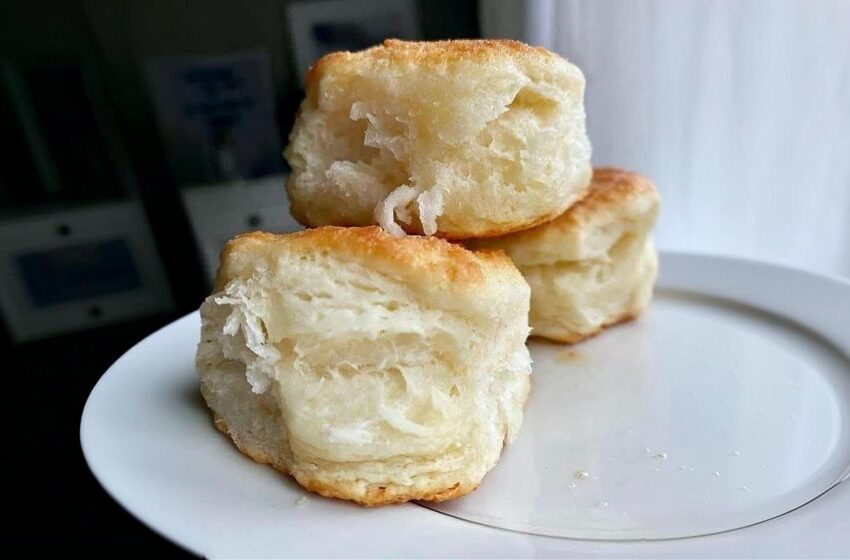
A truly good buttermilk biscuit doesn’t need much to prove itself — a tender, flaky interior, a golden top, and enough structure to hold up to a ladle of sausage gravy or a generous swipe of butter and jam. This recipe delivers exactly that, using just five ingredients most kitchens already have on hand. It’s the kind of foundational recipe worth having memorized, versatile enough to anchor a savory breakfast or serve as a sweet weekend brunch treat, depending entirely on what gets piled on top.
Why Buttermilk Does More Than Add Tang
Buttermilk isn’t in this recipe purely for flavor, though the tang it contributes is real and noticeable. Its acidity also plays a direct role in the biscuit’s texture. When buttermilk’s acid meets the baking soda in this recipe, it triggers a chemical reaction that produces carbon dioxide, giving the biscuits an extra lift beyond what baking powder alone would provide. That combination of baking soda’s acid-triggered reaction and baking powder’s more standard leavening is part of why these biscuits rise properly and end up with a light, tender crumb rather than something dense or flat.
If buttermilk isn’t something you keep on hand regularly, a quick substitute works just as well: stirring 1¼ teaspoons of white vinegar or lemon juice into 1¼ cups of whole milk and letting it sit for about 10 minutes replicates buttermilk’s acidity closely enough for this recipe to work exactly the same way.
Why the Butter Gets Rubbed Into the Flour, Not Melted
Cutting cold butter into slices and rubbing it into the flour with your fingers, rather than melting it and stirring it in, is a technique that directly determines the biscuits’ flakiness. As cold butter is worked into the flour, it doesn’t fully dissolve — instead, it breaks into small, distinct pieces coated in flour, remaining solid rather than blending seamlessly into the dry mixture.
Those small pockets of solid butter are what create flakiness once the biscuits bake. As the dough heats in the oven, the butter pieces melt rapidly, releasing steam that pushes apart the surrounding layers of dough, creating the thin, flaky layers a well-made biscuit is known for. Melted butter, mixed directly into the flour, wouldn’t produce that same layered structure — it would simply coat the flour evenly, resulting in a denser, more uniform texture rather than distinct, flaky layers.
Why the Dough Gets Mixed Only Until “Just Combined”
Once the buttermilk is added, this recipe specifically calls for mixing only until the dough just comes together — not fully smooth, not thoroughly kneaded into a uniform mass. That restraint matters. Flour develops gluten as it’s worked, and while a certain amount of gluten development gives the dough enough structure to hold together, too much turns biscuits tough and chewy rather than tender.
Handling the dough as little as possible, from mixing through the brief kneading step and rolling it out, keeps gluten development to a minimum, preserving the light, tender texture that separates a good biscuit from an overworked, dense one.
The Recipe
Ingredients
- 3 cups all-purpose flour
- 1¼ cups buttermilk
- 1 tablespoon baking powder
- 6 tablespoons salted butter
- ½ teaspoon baking soda
Instructions
- Preheat the oven. Preheat to 450°F.
- Combine the dry ingredients. Mix the flour, baking powder, and baking soda together.
- Work in the butter. Cut the butter into slices and rub it into the flour mixture using your fingers, until the mixture resembles coarse crumbs with small, distinct pieces of butter remaining.
- Add the buttermilk. Slowly pour in the buttermilk, mixing until just combined — avoid overmixing.
- Knead briefly. Turn the dough out onto a floured work surface and knead gently just a few times to bring it together.
- Roll and cut. Roll the dough out to ½-inch thickness and cut out biscuits using a biscuit cutter.
- Bake. Bake for 10 to 12 minutes, until golden on top.
Tips for the Best Results
- Keep the butter cold. Cold butter is what creates flaky layers; if it softens too much while you’re working, a brief chill in the refrigerator before continuing helps.
- Don’t overmix the dough. Mixing just until the ingredients come together, and kneading only briefly, keeps the biscuits tender rather than tough.
- Cut straight down with the biscuit cutter, without twisting. Twisting the cutter can seal the edges of the dough, which interferes with how evenly the biscuits rise.
- Space the biscuits close together on the baking sheet, if you want soft sides. Biscuits placed touching each other rise upward against their neighbors rather than spreading outward, resulting in taller, softer-sided biscuits.
- Serve them warm. Biscuits are at their best fresh from the oven, when the texture is at its lightest and most tender.
Variations Worth Trying
- For a slightly sweet biscuit: add a pinch or two of sugar to the dry ingredients, useful if you’re planning to serve them with jam, honey, or butter.
- For a savory twist: fold in shredded cheese and a pinch of dry mustard for a cheesy, slightly tangy variation, well suited to pairing with soups or stews.
How to Serve Them
These biscuits are genuinely versatile depending on what you top them with. Split and ladled with warm sausage or bacon gravy, they become the base of a classic Southern-style breakfast. Spread simply with butter and jam or honey, they shift toward a lighter, sweeter treat suited to a weekend brunch. However they’re served, they’re best enjoyed warm, straight from the oven.
Storage Instructions
Stored in an airtight container at room temperature, these biscuits keep for 2 to 3 days, though they’re at their best enjoyed fresh, ideally the same day they’re baked.
Why This Recipe Is Worth Keeping on Hand
A reliable biscuit recipe is one of those foundational skills worth having ready at all times, and this one delivers on exactly what a biscuit should be: tender, flaky, and versatile enough to move between a savory breakfast and a sweet weekend treat depending entirely on what’s piled on top. With just five ingredients and a straightforward technique built around a few key details — cold butter, minimal mixing, real buttermilk or a good substitute — these biscuits come together quickly enough for a weekday morning, yet taste special enough for a proper weekend brunch.