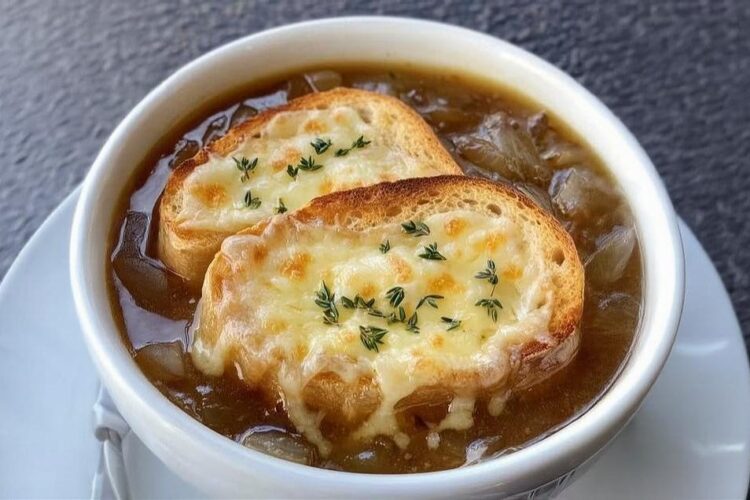
The Timeless, Soul-Warming Classic That Transforms Humble Onions Into Something Deeply Rich, Gooey, and Completely Irresistible — With a Bubbling Gruyère Crust That Defines Comfort Food at Its Most Elegant
Some dishes earn their place in the culinary canon not through novelty or complexity but through a flavor so deeply satisfying, so perfectly constructed, and so completely impossible to improve upon that they simply persist — decade after decade, century after century — as the standard against which all similar comfort food is measured. French Onion Soup is that dish. A bowl of slowly caramelized onions swimming in a deeply savory, herb-perfumed beef broth, topped with a thick slice of toasted baguette and blanketed under a layer of melted, bubbling, golden-brown Gruyère cheese that stretches dramatically with every spoonful — it is one of the most satisfying things a kitchen can produce, and it has been producing it for over three hundred years.
What makes this soup remarkable — and what makes it genuinely achievable in any home kitchen with a pot, a stockpot, and an oven-safe bowl — is that its extraordinary flavor comes almost entirely from patience rather than technique. The onions are the work. Thirty to forty minutes of slow, attentive cooking over medium heat with butter, olive oil, a pinch of salt, and a small amount of sugar transforms four large yellow onions from sharp and pungent raw vegetables into something completely unrecognizable — soft, deeply golden, almost jammy, and sweet in a complex, nuanced way that no other cooking process can replicate. Everything else in the recipe — the broth, the herbs, the wine, the cheese — builds on that foundation. Get the onions right and the soup takes care of itself.
🧅 Why This Recipe Has Been Worth Making for Three Hundred Years
- 🧅 Caramelized Onions Are Transformative: The thirty to forty minutes of patient, low-heat cooking that turns raw onions into deeply golden, sweet, jammy strands is the entire secret of this soup. No shortcut, no substitute, no faster method produces the same result — and the result is so extraordinary that every minute is completely justified.
- 🧀 That Cheese Pull: Gruyère melted under a broiler until it bubbles, browns at the edges, and develops a slightly crispy surface while remaining entirely molten beneath — stretched dramatically by the first spoonful — is one of the great sensory pleasures of the entire culinary world.
- 🍷 Depth From Deglazing: A splash of dry white wine poured into the pot after the garlic and stirred to lift the caramelized bits from the bottom of the pan adds a layer of acidity and complexity to the broth that makes the finished soup taste considerably more sophisticated than its ingredient list suggests.
- ⏰ Better the Next Day: French Onion Soup improves significantly overnight as the flavors meld and deepen in the refrigerator — making it one of the most practical make-ahead dishes for dinner parties, holiday meals, or simply having something extraordinary waiting in the refrigerator at the end of a long week.
- 🌿 Humble Ingredients, Extraordinary Results: Four large onions, butter, broth, herbs, bread, and cheese. The ingredient list is shorter than the reputation of the dish suggests — which is one of the most satisfying things about cooking it for the first time and understanding exactly how something this good comes from something this simple.
📖 From Peasant Food to Fine Dining — The History of French Onion Soup
The history of French Onion Soup is one of the most interesting stories in European culinary history — a dish that began as the most economical possible meal and climbed over three centuries to the top of the French restaurant menu without changing its fundamental character or its essential ingredients in any significant way.
The soup’s origins are traced to 18th century France, where onions — abundant, cheap, and available year-round — were a dietary staple of working-class and rural communities that could not afford the meat and produce that formed the basis of wealthier households’ cooking. A broth made from water or the cheapest available stock, enriched with slowly cooked onions and poured over a piece of bread, was sustenance rather than cuisine — practical, filling, and economical in the way that has always defined peasant cooking.
The transformation of this humble preparation into the gratinée-style dish we know today — ladles of rich, deeply flavored broth crowned with toasted bread and melted cheese and finished under a broiler — happened gradually in the cafés and bistros of 18th and 19th century Paris, where restaurateurs discovered that slow-caramelized onions in a proper beef broth with a generous cheese topping was not merely economical sustenance but something genuinely extraordinary. By the time French cuisine had fully codified in the 19th century, French Onion Soup had earned its place on proper restaurant menus and in serious cookbooks — the former peasant dish transformed into a symbol of French culinary wisdom: that patience and technique can make the humblest ingredient magnificent.
Les Halles, the famous Paris market district that operated from the 12th century until 1971, became particularly associated with the soup — traders and workers would eat bowls of it in the early morning hours in the surrounding cafés, and it became one of the signature dishes of Parisian working-class food culture. Today, it appears on menus from the simplest bistro to the most celebrated restaurant in France and around the world, carrying with it three centuries of cultural history in every bowl.
🛒 What You Will Need
Servings: 4–6 | Equipment: large heavy-bottomed pot or Dutch oven, oven-safe bowls, baking sheet
The Onion Base
- 4 large yellow onions, thinly sliced — the foundation and the soul of the entire dish. Yellow onions are specified over white or red because their higher sugar content produces the deepest, most beautifully golden caramelization and the most complex, rounded sweetness in the finished soup. Thin, even slicing is important — uniform thickness ensures all the onion strands caramelize at the same rate. Use a sharp knife or mandoline for the most consistent results.
- 3 tablespoons unsalted butter — contributes richness, browning, and the fat medium through which the onions slowly caramelize. Unsalted butter gives control over the final seasoning of the soup.
- 1 tablespoon olive oil — combined with the butter for two specific reasons: its higher smoke point prevents the butter from burning during the long caramelization process, and its flavored fat contributes a subtle depth to the onion base that butter alone does not provide.
- 1 teaspoon sugar — added to the onions along with the salt at the beginning of caramelization. The small amount of additional sugar accelerates the Maillard and caramelization reactions, helping the onions develop deeper color and sweeter flavor more efficiently without making the finished soup taste sweet.
- ½ tsp salt and ¼ tsp black pepper — season the onions from the very beginning of cooking, which draws moisture out of the onion cells and speeds the softening process.
- 2 cloves garlic, minced — added after the onions are fully caramelized and cooked for one minute before the wine is added. Garlic added too early would scorch during the long caramelization time; added at this later stage, it contributes a warm, savory aromatic depth without bitterness.
The Broth
- ½ cup dry white wine, optional — poured into the pot after the garlic and stirred vigorously to deglaze — lifting all the flavorful caramelized bits from the bottom of the pot into the liquid. The wine adds acidity, complexity, and a subtle fruit note that enriches the broth considerably. A dry, unoaked white wine — Sauvignon Blanc, Pinot Grigio, or dry Vermouth — is ideal. If omitting the wine, use an equivalent amount of broth.
- 6 cups beef broth — the liquid base of the soup. Quality matters significantly here — a rich, well-flavored beef broth produces a soup with genuine depth, while a thin or watery broth produces a correspondingly thin and disappointing result. Low-sodium broth is recommended so that seasoning can be controlled precisely at the end of cooking.
- 1 tablespoon Worcestershire sauce, optional — adds an umami-rich, slightly tangy depth that amplifies the savory quality of the beef broth and contributes a complexity that is immediately noticeable and completely welcome.
- 2 sprigs fresh thyme or ½ tsp dried — the defining herb of classic French Onion Soup, adding a floral, slightly earthy warmth that perfumes the broth throughout the simmering time.
- 1 bay leaf — contributes a subtle herbal complexity to the broth during simmering and is removed before serving.
The Topping
- 1 baguette, sliced — cut into rounds approximately ¾ inch thick and toasted before going on top of the soup. Toasting is not optional — untoasted bread will become completely soggy and dissolve into the soup within minutes under the broiler, while properly toasted bread maintains its structure, provides a platform for the cheese, and contributes a pleasant crunch beneath the melted Gruyère.
- 2 cups grated Gruyère cheese — the classic and most authentically French choice for this soup, for specific and important reasons. Gruyère melts completely smoothly into a fluid, bubbling, evenly golden layer that stretches with a dramatic, satisfying pull and develops beautiful brown spots under the broiler without becoming greasy or separating. Its nutty, slightly sweet, complex flavor is the perfect complement to the savory, caramelized onion broth below it. Swiss, Comté, or a combination of Gruyère and Parmesan are all excellent alternatives.
👨🍳 Step-by-Step Method
Caramelization time: 30–40 minutes | Simmer time: 20–30 minutes | Assembly and broil time: 5–8 minutes | Total time: approximately 1 hour 15 minutes | Servings: 4–6
Step 1 — Caramelize the Onions: In a large, heavy-bottomed pot or Dutch oven over medium heat, melt the butter and olive oil together. Add all the sliced onions, salt, pepper, and sugar. Stir to coat everything evenly in the fat. Cook, stirring every 3 to 4 minutes, for 30 to 40 minutes — and this timing is the most important instruction in the entire recipe. The onions will go through several distinct stages: first they will become translucent and release significant moisture, then they will begin to soften and reduce dramatically in volume, then they will begin to turn golden at the edges, and finally — after enough patience — they will be uniformly, deeply golden throughout with a jammy, concentrated texture and an extraordinary sweet-savory aroma. Do not rush this process by raising the heat — higher heat produces unevenly browned, slightly bitter onions rather than the uniformly golden, genuinely sweet caramelized result the recipe requires.
💡 Pro Tip: If at any point during caramelization the onions appear to be sticking or beginning to scorch on the bottom of the pot, add a very small splash of water — just 2 tablespoons — and stir it in immediately. The water loosens the stuck bits and incorporates them back into the onions, adding flavor rather than losing it.
Step 2 — Add Garlic and Deglaze: Once the onions are deeply and uniformly golden, add the minced garlic and stir for exactly 1 minute — enough to cook the garlic and develop its flavor without allowing it to burn. Pour in the dry white wine and stir vigorously, scraping the bottom and sides of the pot to lift all the caramelized residue into the liquid. This deglazing step incorporates layers of concentrated, deeply browned flavor into the broth that would otherwise be lost.
Step 3 — Build and Simmer the Broth: Add the beef broth, Worcestershire sauce, fresh thyme sprigs or dried thyme, and bay leaf. Stir to combine everything completely. Increase the heat to bring the soup to a gentle boil, then reduce to a steady simmer and cook for 20 to 30 minutes, allowing all the flavors to meld and deepen. The soup is ready when it smells extraordinarily good and the broth has a visibly deeper color than the plain beef broth you started with. Remove and discard the thyme sprigs and bay leaf. Taste and adjust seasoning with additional salt and pepper as needed.
Step 4 — Toast the Baguette: While the soup simmers, preheat your broiler. Arrange the baguette slices on a baking sheet and broil for 1 to 2 minutes per side until both sides are firmly toasted and golden — not just warm, but genuinely crisp and dry throughout. Set aside. Toasted bread that maintains its structure when placed on the soup and under the broiler is the difference between a proper gratinée topping and a soggy, dissolved disappointment.
Step 5 — Assemble and Broil: Ladle the hot soup into oven-safe bowls — only oven-safe bowls can go under the broiler safely. Place the bowls on a sturdy baking sheet, which makes moving them in and out of the broiler significantly safer. Place one or two toasted baguette slices over the surface of the soup in each bowl. Cover the bread and soup surface generously and completely with grated Gruyère cheese — be generous, as the cheese will reduce as it melts and a thin layer will produce a disappointing result. Place the baking sheet with the filled bowls under the preheated broiler and broil for 2 to 3 minutes, watching constantly throughout, until the cheese is completely melted, actively bubbling, and developed golden-brown spots and slightly darker patches at the edges.
Step 6 — Serve Immediately: Remove the bowls from the oven — they will be extremely hot, so use thick oven mitts and warn anyone receiving a bowl. Serve immediately while the cheese is at its most molten and the bread is still crisp beneath it. The first spoonful, breaking through the cheese crust into the caramelized onion broth below, is the moment this recipe has been building toward for over an hour — and it is worth every minute of the wait.
🍽️ Serving Suggestions and Storage
Serve this soup as a starter before a simple roast or grilled protein, or as a complete main course alongside a crisp green salad with a sharp vinaigrette and a glass of dry white wine or a light red. The soup is substantial enough — particularly with the bread and cheese topping — to be a full evening meal without feeling incomplete. For storage, cool the soup base only — without the bread and cheese — in shallow airtight containers and refrigerate for up to 4 days. The flavor deepens and improves overnight and the day-two version is genuinely better than the freshly made one. Reheat on the stovetop over medium heat, taste and adjust seasoning, then assemble fresh bread and cheese toppings and broil immediately before serving. The soup base also freezes well for up to 3 months — freeze in individual portion-sized containers for the most practical future use.
💡 Tips and Variations
For a more complex, restaurant-quality broth, add a small splash of brandy or dry sherry to the pot along with the wine during deglazing — the spirits add a sophisticated aromatic depth that makes the finished soup taste noticeably more elevated. For a meatier, more substantial version, add 1 cup of thinly sliced cremini mushrooms to the onions during the final 10 minutes of caramelization — they contribute an earthy, umami richness that complements the caramelized onion flavor beautifully. For a plant-based version, substitute equal amounts of good-quality vegan butter and vegetable broth — use a rich, full-bodied vegetable broth rather than a thin one, and omit the Worcestershire sauce or substitute a vegan-certified version. For extra cheese complexity, mix equal parts Gruyère and freshly grated Parmesan — the Parmesan adds a salty, sharp note and develops a more dramatically browned crust under the broiler.
❓ Frequently Asked Questions
Can I speed up the onion caramelization? Technically, raising the heat produces browned onions more quickly — but not properly caramelized ones. Higher heat produces uneven browning, bitter scorched patches, and a result that lacks the deep, uniform sweetness of properly caramelized onions. The thirty to forty minutes at medium heat is not a suggestion — it is the method. There is no shortcut that produces the same result.
What if I do not have oven-safe bowls? Make the soup and assemble the baguette and cheese topping on a separate baking sheet — lay toasted bread slices on the sheet, cover generously with cheese, and broil until melted and golden, then float one over each bowl of soup just before serving. The result is less dramatic than the traditional gratinée style but still delicious.
My onions are burning rather than caramelizing — what should I do? Reduce the heat immediately and add a small splash of water to the pot, stirring to incorporate any stuck bits. Burning onions are the result of heat that is too high — true caramelization happens slowly at medium to medium-low heat, not quickly at high heat. Start lower than feels necessary and be patient.
Can I make this soup a day ahead? Yes — and you should. Make the complete soup base, cool it completely, and refrigerate overnight. The flavors meld and deepen significantly overnight and the day-two version is noticeably more complex and satisfying than the freshly made one. Reheat on the stovetop, assemble the bread and cheese topping fresh, and broil immediately before serving.
🌟 A Final Word
Thirty to forty minutes of patient onion caramelization. A gentle, herb-perfumed simmer. Toasted bread. An extraordinarily generous layer of Gruyère under a hot broiler for two to three minutes. And then a bowl of something so rich, so deeply flavored, and so completely satisfying that it has been worth making in essentially the same way for three hundred years.
French Onion Soup is the recipe that reminds you why patience is the most valuable cooking skill — not technique, not equipment, not exotic ingredients, but the simple willingness to stand at a stove and stir onions slowly for forty minutes because you know what those forty minutes will produce. The reward is a soup that tastes like the culmination of everything good about slow cooking: complex, deeply flavored, humble in origin and extraordinary in result, with a cheese-crowned finish that is one of the most genuinely pleasurable things you will ever pull from under a broiler. Make it on a cold evening. Make it a day ahead when you can. Make it for people you want to impress with something that requires patience rather than skill. And understand, as you watch the cheese bubble and brown and stretch with the first spoonful, exactly why this humble peasant soup became one of the most celebrated dishes in the world — because some things are simply, undeniably, irreversibly worth the time they take.