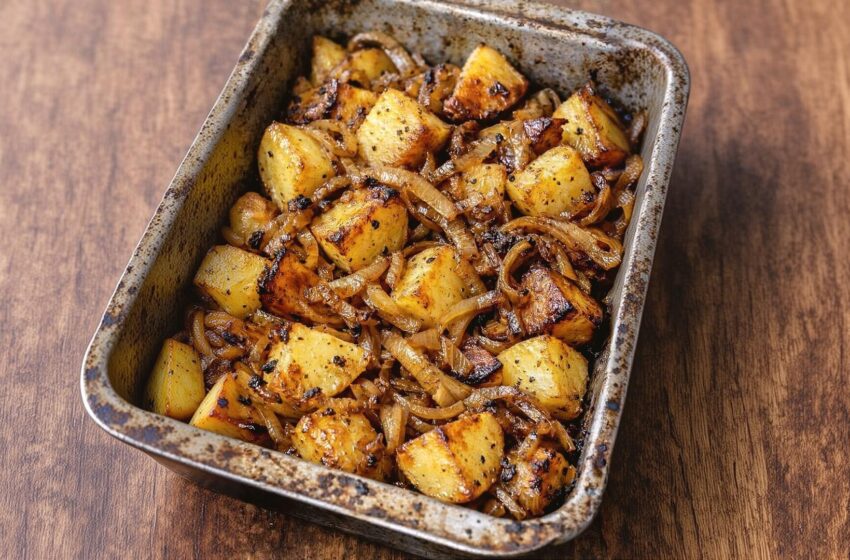
There’s a particular kind of dish that doesn’t announce itself with elaborate ingredients or technique, but earns its place at the table through pure consistency — the pan that shows up every single Sunday, filling the house with the smell of buttery potatoes and sweet, caramelized onions long before anyone’s called to the table. This Amish-style roasted potatoes and onions recipe is exactly that kind of dish: four ingredients, a bit of oven time, and no fuss whatsoever.
It’s the kind of recipe that reflects Amish home cooking at its core — simple, budget-friendly staples, transformed through patience and slow, steady heat rather than anything complicated.
Why the Onions Get Cut Thick, Not Thin
This recipe is specific about slicing the onions into thick half-moons, roughly ½-inch, rather than thin slices — and that thickness matters considerably given how long everything spends in the oven. Onions sliced too thin would burn and turn bitter well before the potatoes have had time to fully cook through, since thinner pieces have less mass and dry out faster under sustained heat. Cutting them thick enough gives the onions the staying power to survive the full 45 to 55 minutes of roasting, softening and caramelizing gradually rather than scorching early.
Why Spacing the Vegetables Out Matters So Much
Spreading the potatoes and onions into as even a layer as possible, without piling them too deep, is a small detail with a real impact on the final texture. Overcrowded vegetables in a roasting pan trap steam between the pieces, which softens them through moisture rather than allowing direct contact with the hot pan and oven air — the difference between roasting and steaming. Keeping the layer relatively shallow, even if it means using a slightly larger pan, gives the potatoes and onions the airflow and direct heat contact they need to properly brown and caramelize rather than turning soft and pale.
Why the First 25 Minutes Go Untouched
This recipe specifically calls for baking the first 25 minutes without stirring, letting the bottoms start to brown and the onions begin to soften undisturbed. That initial stretch of contact with the hot pan is what builds the foundation of caramelization — stirring too early would disrupt that developing browned layer before it’s had a chance to form, resetting the process rather than building on it. Only after that first stretch does the recipe call for tossing everything and scraping up the golden bits from the bottom of the pan, redistributing that flavor throughout the dish rather than losing it stuck to the pan.
The Recipe
Servings: 4
Ingredients
- 2 pounds russet or yellow potatoes, scrubbed and cut into 1-inch chunks
- 2 large yellow onions, peeled and sliced into thick half-moons
- 4 tablespoons unsalted butter, melted (plus a little extra for greasing the pan)
- 1½ teaspoons kosher salt, or to taste
Directions
- Preheat and prep the pan. Preheat the oven to 400°F (200°C). Lightly grease a metal baking pan (8×11 or 9×13 works well) with a small pat of butter.
- Prep the potatoes. Scrub the potatoes well and cut them into roughly 1-inch chunks so they cook evenly. Leaving the skins on adds extra texture and saves prep time.
- Slice the onions. Cut the onions into thick half-moons, about ½-inch thick, so they hold up through the full roasting time.
- Add to the pan. Add the potato chunks and onion slices to the prepared pan, spreading them into as even a layer as possible. A little overlap is fine, but avoid piling too deep.
- Season. Drizzle the melted butter evenly over the potatoes and onions, then sprinkle with kosher salt. Toss everything in the pan with clean hands or a large spoon until evenly coated.
- First bake. Spread the mixture back into an even layer, making sure onion slices are nestled among the potatoes. Bake on the middle rack for 25 minutes without stirring.
- Stir and continue. After 25 minutes, remove the pan and toss everything well, scraping up any golden bits from the bottom. Spread back into an even layer and return to the oven.
- Finish roasting. Continue roasting for another 20 to 30 minutes, stirring once or twice, until the potatoes are tender throughout, the edges are deeply golden, and the onions are soft, sweet, and caramelized in spots. Total time is about 45 to 55 minutes.
- Serve. Taste and add a pinch more salt if needed. Serve hot, straight from the pan, scooping up the caramelized onion bits and buttery drippings from the bottom.
Tips for the Best Results
- Cut the potatoes into consistent, roughly 1-inch pieces. Uniform sizing ensures even cooking throughout.
- Don’t skip the undisturbed first 25 minutes. This is essential for building the initial layer of browning on the bottom.
- Avoid overcrowding the pan. Vegetables piled too deep will steam rather than roast, missing out on that caramelized flavor and texture.
- Scrape up the browned bits when stirring. That’s where a lot of concentrated flavor is hiding, and redistributing it improves the whole dish.
- For crisper edges, use a lower rack and a less crowded pan. For a softer, more casserole-style result, cover loosely with foil for the first 20 minutes before uncovering to finish browning.
Variations Worth Trying
- For extra richness: dot an additional tablespoon or two of butter over the top during the last 10 minutes of baking.
- For more color: use a mix of red and yellow potatoes, or swap in sweet onions for an even more caramelized flavor.
- To stretch the recipe for a crowd: add up to 1 extra pound of potatoes and 1 more onion, increasing the butter and salt slightly, and use a larger pan to avoid overcrowding.
Make-Ahead Tips
For a busy day, the potatoes and onions can be cut in the morning, tossed with melted butter and salt, covered, and refrigerated right in the pan. Give everything a quick toss before roasting as directed, adding 5 to 10 extra minutes if going into the oven cold.
What to Serve With It
These potatoes and onions pair naturally with classic Sunday mains like roast chicken, meatloaf, baked ham, or pot roast, but they work just as well alongside simpler weeknight proteins like pan-seared pork chops or baked salmon. A crisp green salad or steamed green beans rounds out the plate nicely.
Leftover Ideas
Leftovers reheat beautifully in a skillet, and a fried egg on top turns them into an easy, satisfying breakfast or quick lunch the next day.
Why This Simple Dish Has Earned Its Sunday Tradition Status
What makes a recipe like this one worth repeating every single week isn’t complexity — it’s the opposite. Four ingredients, a bit of patience with the oven, and a technique built around a few key details — thick-cut onions, proper spacing, an undisturbed first bake — produce something genuinely comforting and full of flavor. It’s easy to see why a dish this simple has become the kind of tradition that draws a whole family to the table, week after week.