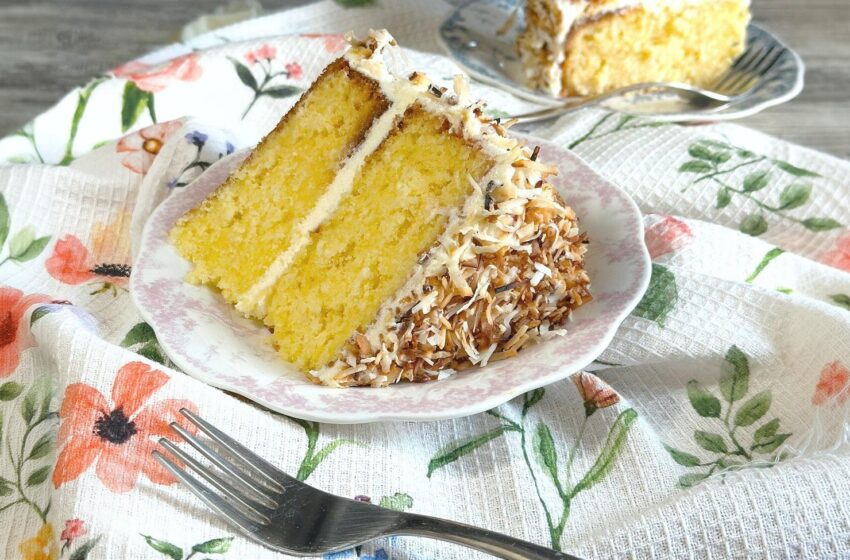
When Dolly Parton launched her own line of cake mixes, the coconut version became something of a legend almost immediately — beloved, then discontinued, then endlessly requested by fans who never managed to get their hands on a second box. This from-scratch version aims to recreate that specific magic without needing the actual mix: a tender, buttery cake full of vanilla, wrapped in a velvety cream cheese frosting and finished with a generous coat of toasted coconut.
It captures the same classic Southern coconut cake spirit Dolly’s mix was known for, built from real ingredients rather than a boxed shortcut, with a texture and balance that lands right in that sweet spot between rich and light.
Why This Cake Uses So Much Butter Relative to Other Ingredients
With a full 20 tablespoons of butter in the cake batter alone, this recipe leans considerably richer than a standard layer cake. That generous butter content is central to achieving the tender, almost melt-in-your-mouth crumb the recipe is known for. Butter coats the flour’s proteins as it’s creamed with sugar, which limits gluten development and produces a softer, more delicate texture than a cake built with less fat relative to its dry ingredients. It’s part of why this cake reads as genuinely indulgent rather than just sweet — the richness comes through in texture as much as flavor.
Why the Dry Ingredients and Buttermilk Get Added in Alternating Stages
Rather than dumping all the flour mixture in at once, followed by all the buttermilk, this recipe calls for alternating between the two — three additions of dry ingredients, two of buttermilk, beginning and ending with the dry ingredients. That alternating method prevents the batter from breaking or curdling, which can happen when a large amount of liquid is added all at once to a batter already built up with creamed butter, sugar, and eggs. Starting and ending with the dry ingredients also helps stabilize the batter’s structure, while the buttermilk interspersed between additions keeps things from becoming too stiff to properly incorporate.
Buttermilk itself plays a specific role beyond moisture — its acidity interacts gently with the baking soda in the recipe, contributing to a slightly more tender crumb than regular milk would provide.
Why Coconut Appears Twice, in Two Different Forms
This cake uses coconut in two distinct ways: a smaller amount of shredded coconut folded directly into the batter, and a much larger quantity of toasted shredded coconut pressed onto the finished, frosted cake. Each serves a different purpose. The coconut folded into the batter distributes coconut flavor and a bit of texture throughout the cake itself, ensuring every bite carries some of that flavor, not just the exterior. The toasted coconut coating the outside, meanwhile, is purely about the finishing experience — its toasted, slightly crisp texture provides a textural contrast against the smooth, rich cream cheese frosting underneath, while its golden color gives the cake its classic, recognizable coconut-cake appearance.
Why the Frosting Balances Cream Cheese With Butter
Rather than relying purely on cream cheese for the frosting, this recipe combines it with a full cup of butter, and that ratio matters for both flavor and structure. Cream cheese alone can make for a frosting that’s tangier and softer-set; adding butter alongside it firms up the texture, making it easier to spread evenly and hold its shape once applied to the cake, while also tempering some of the cream cheese’s sharpness with butter’s milder richness. That balance — tangy but not overwhelming, rich but still light enough to spread cleanly — is part of what keeps the finished cake from tipping into overly sweet territory.
The Recipe
Yield: Serves about 10 to 12
Prep time: 25 minutes
Cook time: 35 minutes
Inactive time: 45 minutes
For the cake:
- 2½ cups all-purpose flour
- 1 teaspoon kosher salt
- 1 teaspoon baking powder
- ½ teaspoon baking soda
- 20 tablespoons unsalted butter, room temperature
- 2 cups granulated sugar
- 1 teaspoon vanilla extract
- 5 large eggs, room temperature
- 1 cup buttermilk, room temperature
- ½ cup sweetened shredded coconut
For the cream cheese frosting:
- 16 ounces cream cheese, very soft
- 1 cup unsalted butter, room temperature
- 3 to 4 cups powdered sugar
- 1 teaspoon vanilla extract
- ½ teaspoon fine salt
- 2 cups sweetened shredded coconut, toasted
To make the cake:
- Preheat and prep. Preheat the oven to 350°F. Spray two 8-inch pans with baking spray and line the bottoms with parchment paper.
- Combine dry ingredients. In a large bowl, whisk together the flour, salt, baking powder, and baking soda.
- Cream the butter and sugar. In another bowl, beat the butter and sugar until light and fluffy, about 2 to 3 minutes, scraping the bowl periodically.
- Add the eggs and vanilla. Add the eggs one at a time, beating well after each addition, then add the vanilla extract.
- Alternate dry ingredients and buttermilk. Add the dry ingredients alternately with the buttermilk, in 3 additions of dry ingredients and 2 of buttermilk, beginning and ending with the dry ingredients.
- Fold in the coconut. Gently fold in the shredded coconut.
- Divide and bake. Divide the batter between the prepared pans, tapping lightly to remove air bubbles. Bake for 35 to 45 minutes, until a toothpick comes out mostly clean with a few moist crumbs.
- Cool. Let the cakes cool in the pans for 5 minutes before inverting onto a wire rack to cool completely.
To make the frosting and assemble the cake:
- Beat the cream cheese and butter. Beat until very smooth and well combined, about 2 to 3 minutes, scraping the bowl periodically.
- Add the remaining ingredients. Gradually add the powdered sugar, followed by the vanilla and salt.
- Level and layer. If the cake layers have domes, use a serrated knife to flatten them. Use frosting to secure one layer onto a cake board or plate, spread frosting evenly on top, then add the second layer.
- Frost the cake. Frost the top and sides using an offset spatula to smooth the frosting evenly.
- Coat with coconut. Press the toasted coconut onto the frosted cake to coat.
Tips for the Best Results
- Use room-temperature ingredients throughout. This ensures the batter and frosting both come together smoothly without lumps.
- Toast the coconut carefully. It can go from golden to burnt quickly, so watch closely and stir often if toasting in a skillet or on a baking sheet.
- Level domed cake layers before stacking. This makes for a more even, professional-looking final cake.
- Scrape the bowl often while creaming and beating. This ensures every ingredient gets fully incorporated rather than sitting unmixed at the bottom.
Serving Suggestions
This cake is versatile enough to fit into nearly any seasonal occasion — a springtime Easter spread, a summer gathering alongside fresh berries, or a showstopping holiday dessert centerpiece. Its balanced sweetness and tender crumb make it satisfying without being heavy, which is part of why it holds up well across so many different settings.
Why This From-Scratch Version Earns Its Reputation
What makes this cake worth the extra effort of baking from scratch, rather than chasing down a discontinued mix, is how carefully it’s built to hit the right balance: rich but not dense, sweet but not cloying, coconut-forward without being one-note. Real butter, properly alternated wet and dry ingredients, and coconut used in two distinct, purposeful ways all combine into a cake that captures everything people loved about the original mix — and arguably delivers even more, given the care that goes into a genuine from-scratch bake.