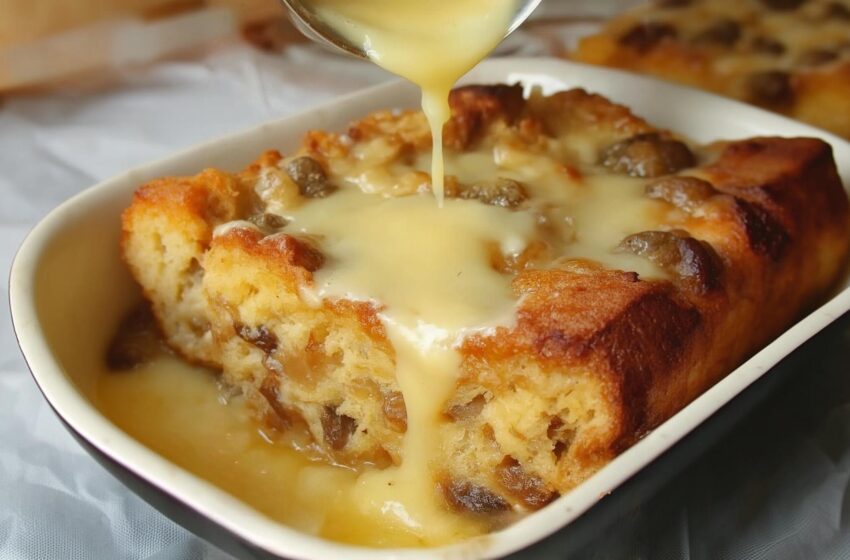
Long before “zero-waste cooking” became a phrase anyone used, grandmothers were already practicing it in the form of bread pudding. This dessert exists because of a simple, practical idea: day-old bread, too stale to enjoy on its own, doesn’t need to be thrown away — it just needs to be soaked, sweetened, and baked into something entirely new. What comes out of the oven bears almost no resemblance to the dry, forgotten loaf it started as. Instead, it’s custardy, warmly spiced, and finished with a rich vanilla sauce that turns a humble pantry solution into genuine dessert-table material.
Why Day-Old Bread Is Actually the Right Choice
It might seem counterintuitive that stale bread makes a better dessert than fresh bread, but in this case, staleness is an advantage rather than a flaw. Fresh, soft bread is already saturated with moisture, which means it has very little capacity left to absorb the custard mixture it’s about to be soaked in. Day-old bread, on the other hand, has dried out just enough to develop tiny air pockets and a firmer structure, both of which make it far more absorbent.
That absorbency is the entire mechanism behind bread pudding. As the cubed bread sits in the milk-and-egg mixture, it soaks up the liquid custard almost like a sponge, softening from the outside in while still holding its shape well enough to bake into distinct, tender pieces rather than dissolving into a shapeless mush. Fresh bread, lacking that dried-out structure, tends to turn gummy and overly dense instead.
The Custard Base: What’s Actually Happening in the Oven
At its core, bread pudding is really a baked custard with bread suspended throughout it. The combination of milk, eggs, sugar, vanilla, and a touch of cinnamon and salt forms a mixture nearly identical to what you’d use for a crème brûlée or flan — it’s the eggs that do the real transformative work here, setting as they bake and binding the soaked bread into a cohesive, sliceable dessert rather than leaving it as loose, wet chunks.
Pressing the bread down into the milk mixture before baking matters more than it might seem. Bread that’s left floating on top of the custard, rather than fully submerged, won’t absorb liquid evenly, leading to a finished pudding with dry, under-soaked patches next to overly wet ones. A firm press ensures every cube gets equal contact with the custard before the oven sets everything in place.
Why the Vanilla Sauce Isn’t Optional
While bread pudding can technically stand on its own, the vanilla sauce that traditionally accompanies it does real work beyond just added sweetness. Made from heavy cream, sugar, vanilla, and butter, it’s essentially a simplified crème anglaise — a pourable, rich sauce that adds moisture back into a dessert that, however good, can dry out slightly at the edges during baking.
Drizzled warm over a warm slice of bread pudding, the sauce seeps into the top layer, reintroducing richness and a silky texture that contrasts nicely against the slightly firmer, more structured custard underneath. It’s the difference between a good bread pudding and one that feels genuinely indulgent.
The Recipe
For the Bread Pudding:
- 4 cups cubed day-old bread
- 2 cups milk
- ½ cup sugar
- 3 large eggs
- 1 teaspoon vanilla extract
- ½ teaspoon ground cinnamon
- ¼ teaspoon salt
- ¼ cup melted butter
- ½ cup raisins (optional)
For the Vanilla Sauce:
- ½ cup heavy cream
- ¼ cup sugar
- ½ teaspoon vanilla extract
- 1 tablespoon butter
Preparation
- Preheat and prep. Preheat the oven to 350°F (175°C) and grease a 9×9-inch baking dish.
- Make the custard. In a bowl, whisk together the milk, sugar, eggs, vanilla, cinnamon, salt, and melted butter until fully combined and smooth.
- Soak the bread. Place the cubed bread in the prepared baking dish, then pour the milk mixture evenly over it. Press the bread down firmly so it soaks evenly and fully absorbs the custard. Sprinkle raisins on top, if using.
- Bake. Bake for 40 to 45 minutes, until the pudding is set throughout and golden on top.
- Make the vanilla sauce. While the pudding bakes, combine the cream, sugar, and vanilla in a saucepan. Heat over medium, stirring occasionally, until the sugar fully dissolves. Stir in the butter and let the sauce simmer for 2 to 3 minutes, until slightly thickened.
- Cool slightly and serve. Remove the bread pudding from the oven and let it cool slightly before serving. Serve warm, with the vanilla sauce drizzled generously over each portion.
Tips for the Best Results
- Let the bread dry out on purpose if it isn’t already stale. If your bread is still fresh, cube it and leave it uncovered at room temperature for a few hours, or toast it lightly in a low oven, before starting the recipe.
- Press the bread down thoroughly before baking. This single step does more for even texture than almost anything else in the process.
- Check for doneness by looking at the center, not just the top. A golden top can appear before the very center has fully set, so a gentle jiggle test — a slight wobble rather than a liquid sloshing — is a more reliable indicator.
- Warm the vanilla sauce again just before serving if it’s made ahead. The sauce is meant to be poured while still warm and pourable; if it’s cooled and thickened, a brief reheat over low heat brings it back to the right consistency.
- Any sturdy bread works. French bread, brioche, and challah are all classic choices, though even a plain sandwich loaf works well once it’s gone slightly stale.
Variations Worth Trying
- Swap the raisins. Dried cranberries, chopped dates, or dark chocolate chips all work as substitutes for raisins, each shifting the flavor in a different direction.
- Add citrus zest. A bit of orange or lemon zest stirred into the custard mixture brightens the overall flavor against the warmth of the cinnamon.
- Try a different spice blend. Nutmeg, allspice, or a touch of ginger can stand in for or complement the cinnamon, depending on the season.
- Make it richer. Swapping part of the milk for half-and-half deepens the custard’s richness, though it also makes for a denser final pudding.
Storage Notes
Bread pudding keeps well in the refrigerator, covered, for up to 3 to 4 days. Reheat individual portions in the microwave, or warm the whole dish covered in a low oven, until heated through. The vanilla sauce can be stored separately in the refrigerator and gently rewarmed before serving — it’s best made fresh or reheated just before pouring, since it firms up considerably once cold.
A Dessert Built on Practicality, Still Beloved for Its Comfort
What’s remarkable about bread pudding is how a dessert born out of necessity — a way to avoid wasting bread that had gone past its best — has held on as a genuine comfort food across generations. There’s nothing fussy about it: a bowl of custard, a pile of stale bread, and an oven do almost all the work. But the warmth, the spice, and that rich vanilla sauce poured over the top turn something practical into something people request by name, long after anyone remembers it started as a way to use up leftovers.